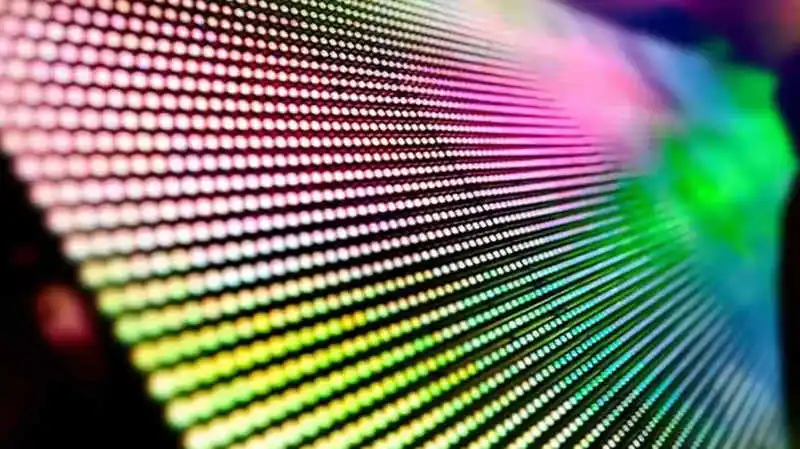
If you've researched LED walls at all, you've probably heard the same question come up immediately: "What's the pixel pitch?" 2.6mm. 1.5mm. 1.2mm. The assumption is simple. Smaller number equals better picture.
Pixel pitch absolutely matters. But it's only one variable in a much bigger system. And in many cases, it's not even the most important one.
After decades of producing live events and deploying LED walls across conferences, galas, festivals, and corporate keynotes, we've learned something simple: the best LED wall picture is not built on a millimeter measurement. It's built on engineering.
When Pixel Pitch Isn't the Priority
There are plenty of events where a premium tight-pitch wall is unnecessary.
If the LED is primarily serving as scenic "wall dressing," ambient branding, or a large logo backdrop, the audience is often far enough away that the difference between 1.5mm and 2.6mm is virtually invisible. At 40, 60, or 100 feet, the human eye simply cannot resolve that extra density.
In those scenarios, what matters more is proper scaling, clean assembly, balanced brightness, and well-formatted content. A properly installed mid-pitch wall will look fantastic and deliver exactly what the event needs.
Not every application requires the most expensive panel on the market. But that equation changes quickly when people move closer.
When Quality Becomes Non-Negotiable
Now consider a corporate keynote, a fundraising gala, or a leadership conference where the audience is seated 8 to 20 feet from the screen. Imagine projecting a CEO's face 12 feet tall behind them. Imagine live cameras capturing subtle skin tones and tight camera shots.
In those moments, every detail shows.
This is where premium panels like those manufactured by ROE Visual make a difference.
The difference isn't just pixel density. It's color consistent from panel to panel. It's refresh rate that works cleanly with broadcast cameras. It's black level performance. It's mechanical precision so seams disappear instead of distracting.
If you've ever seen IMAG where one side of a speaker's face looks slightly green and the other slightly magenta, that's not a pixel pitch issue. That's a calibration and processing issue. And that's where real expertise shows up.
Why 1–2mm Alone Doesn't Guarantee a Great Picture
Tight pitch walls like 1.5mm and 2.6mm are extremely popular in corporate environments right now. They can be phenomenal. But only when deployed correctly.
A 1.5mm wall without proper processing, calibration, and camera shading will often look worse than a well-tuned 3.7mm wall.
LED is a system. The panels are just one component.
Picture quality depends on:
- Proper processing and scaling
- Dedicated LED engineering
- Camera shading that matches stage lighting
- Correct brightness for the room
- Audience distance planning
Without those elements, the extra pixel density is wasted. In fact, tighter pitch panels can exaggerate imperfections if the signal chain and calibration aren't dialed in.
The Work You Don't See
When an LED wall looks perfect, most guests assume it was easy. It wasn't.
Behind the scenes, our LED engineer is mapping panels, verifying data distribution, checking for module uniformity, balancing brightness across the surface, and adjusting color profiles to match the lighting design. When IMAG is involved, a dedicated color shader is matching cameras to the LED wall so skin tones stay natural even as stage lighting shifts.
That extra effort is invisible to the audience. But it's the difference between "good enough" and "world-class." At DC Live, if even one of the 64 diodes in a tile fails, we replace the entire LED tile to maintain a flawless display. Always.
Audience Distance Changes Everything
One of the most overlooked variables in LED design is viewing distance.
An intimate ballroom where guests are seated 10 feet from the screen requires a completely different approach than a festival field or arena.
The best solution depends on how close your audience is, how much IMAG is involved, what kind of content is being displayed, and how the lighting environment behaves. There isn't a universal "best" wall. There's only the right wall for the right environment, engineered correctly.
The Real Answer
So what makes the best LED wall picture?
It's not just pixel pitch.
It's selecting the right product for the application. It's deploying premium panels when the environment demands it. It's engineering the signal path. It's calibrating the surface. It's shading cameras properly. It's planning for audience proximity.
If your event is built around brand, leadership visibility, or high-stakes messaging, the LED wall should be treated like the centerpiece it is. And that requires more than choosing the smallest millimeter number on a quote.
Technology alone does not create a premium image. Execution does.